

Overview
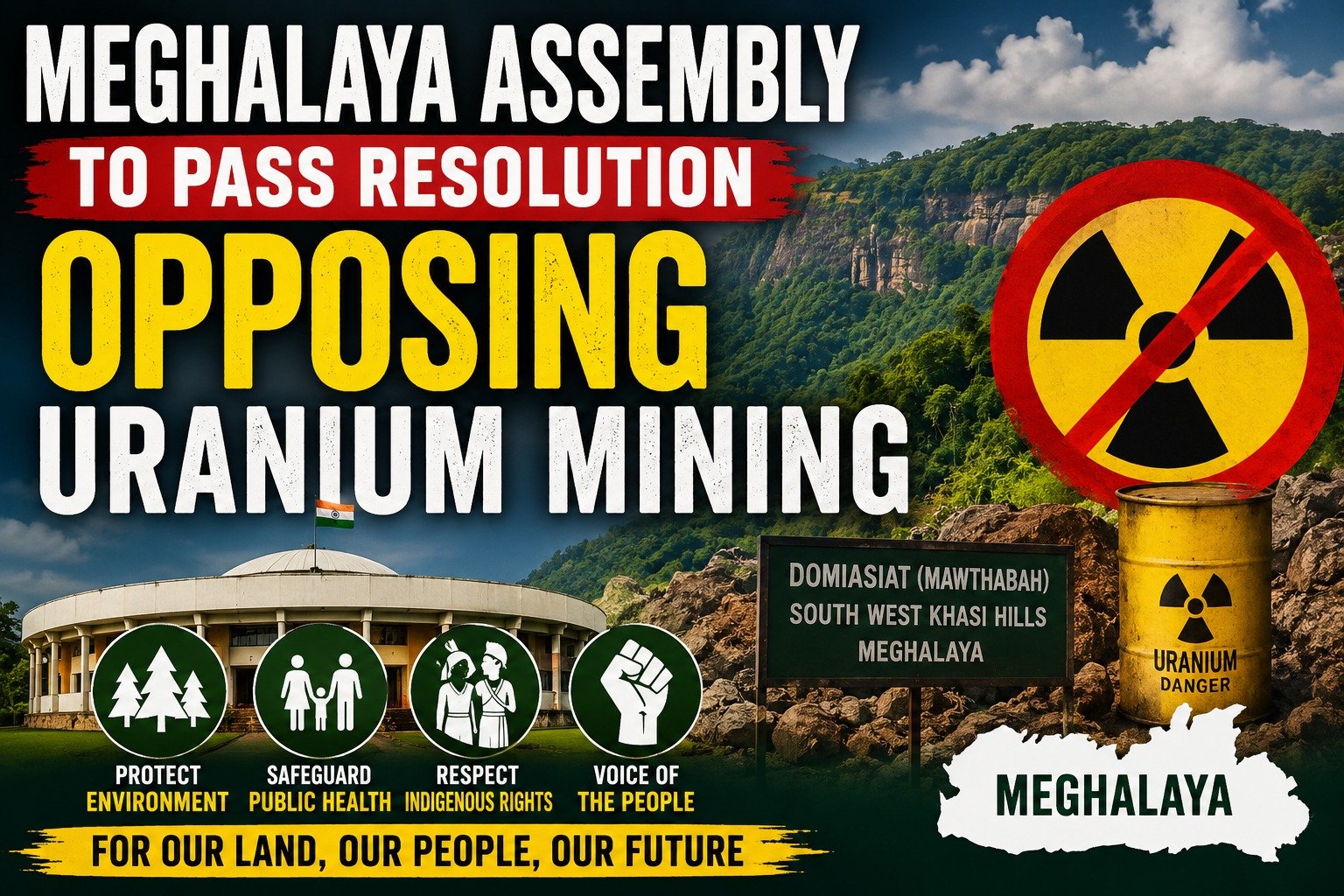
The Meghalaya Government has decided to introduce a resolution in the Meghalaya Legislative Assembly opposing uranium mining in the state. The decision reflects the government’s commitment to protecting the environment, public health, and the interests of indigenous communities.
Although Meghalaya possesses significant uranium reserves—especially in the Domiasiat (Mawthabah) area of South West Khasi Hills district—uranium mining has remained a highly debated issue for many years.
Why is the Government Opposing Uranium Mining?
The government has cited several reasons:
1. Environmental Concerns
- Uranium mining can lead to:
- Radioactive contamination of soil and water.
- Deforestation and destruction of biodiversity.
- Long-term environmental degradation.
2. Public Health Risks
- Exposure to radioactive materials may increase the risk of:
- Cancer.
- Respiratory diseases.
- Genetic disorders.
- Local communities have repeatedly expressed concerns about possible health hazards.
3. Protection of Indigenous Communities
- Many Khasi communities depend on forests, agriculture, and natural water sources.
- Mining activities could affect their traditional livelihoods and cultural heritage.
4. Public Opposition
- Several local organizations, village councils, and civil society groups have opposed uranium mining for decades.
- Public protests and awareness campaigns have played an important role in shaping government policy.
Where is the Uranium Deposit?
The major uranium deposit is located at:
- Domiasiat (Mawthabah)
- South West Khasi Hills District
- Estimated to be one of India’s largest uranium deposits.
Which Organisation Wanted to Mine Uranium?
The Uranium Corporation of India Limited (UCIL) had proposed mining uranium in Meghalaya for use as fuel in India’s nuclear power programme.
Importance of Uranium
Uranium is mainly used for:
- Generating electricity in nuclear power plants.
- Producing nuclear fuel.
- Scientific research.
- Defence-related nuclear applications.
Significance of the Resolution
The proposed Assembly resolution:
- Demonstrates Meghalaya’s commitment to environmental conservation.
- Reflects the concerns and aspirations of local communities.
- May strengthen the state’s position in future discussions with the Central Government regarding uranium exploration and mining.
Examination Points
| Topic | Details |
|---|---|
| Issue | Opposition to uranium mining |
| State | Meghalaya |
| Major Uranium Deposit | Domiasiat (Mawthabah) |
| District | South West Khasi Hills |
| Proposed Mining Agency | Uranium Corporation of India Limited (UCIL) |
| Main Concerns | Environment, health, indigenous rights |
| Purpose of Resolution | To oppose uranium mining in Meghalaya |
Practice MCQs
1. The proposed resolution of the Meghalaya Legislative Assembly relates to:
A. Limestone mining
B. Coal mining
C. Uranium mining
D. Gold mining
Answer: C. Uranium mining
Explanation: The Assembly plans to pass a resolution opposing uranium mining in the state.
2. The major uranium deposit in Meghalaya is located at:
A. Cherrapunji
B. Nongstoin
C. Domiasiat (Mawthabah)
D. Tura
Answer: C. Domiasiat (Mawthabah)
Explanation: Domiasiat, also known as Mawthabah, in South West Khasi Hills district is the state’s principal uranium deposit.
3. Uranium Corporation of India Limited (UCIL) is primarily associated with:
A. Petroleum extraction
B. Uranium mining
C. Coal transportation
D. Hydroelectric projects
Answer: B. Uranium mining
Explanation: UCIL is the Government of India’s public sector company responsible for uranium mining and processing.
4. Which of the following is NOT a major concern regarding uranium mining in Meghalaya?
A. Radioactive contamination
B. Public health risks
C. Biodiversity loss
D. Increase in tourism
Answer: D. Increase in tourism
Explanation: The debate focuses on environmental, health, and social concerns rather than tourism.
5. The proposed Assembly resolution mainly aims to:
A. Promote nuclear power plants in Meghalaya
B. Encourage uranium exports
C. Protect the environment and local communities
D. Increase mineral production
Answer: C. Protect the environment and local communities
Explanation: The resolution reflects concerns over environmental protection, public health, and the rights of indigenous communities.
One reply on “Meghalaya Assembly to Pass Resolution Opposing Uranium Mining (July 2026)”
rumutcosofficial@gmail.com July 21, 2026 at 5:39 am
Damb